

Safe Liposuction Alternatives in Dallas: Compare Options
If you’re searching for safe alternatives to liposuction Dallas residents can consider, remember that a less-invasive option isn’t automatically safer for every person. The right fit depends on your health, treatment goals, and the provider’s qualifications, not just whether a procedure is surgical. It’s understandable to want to avoid anesthesia, incisions, and a lengthy recovery, but non-surgical treatments have their own limits and possible side effects.
This guide compares liposuction with non-surgical body-contouring approaches, explains how fat reduction differs from weight loss and skin tightening, and outlines questions to ask before choosing a treatment. You’ll also learn what candidacy and realistic results can depend on, so you can weigh options and discuss your health history openly with a qualified provider.
Contour Body Imaging offers non-surgical services including Cryo T-Shock, Endosphere, LymphaPress, and Lumaray 360. Its listed locations are in Plano and The Woodlands, Texas, rather than Dallas. These treatments aren’t guaranteed substitutes for surgery, and suitability varies. As you compare options around Dallas, consider the provider’s qualifications, the treatment’s intended purpose, possible side effects, and what results you can reasonably expect.
Table of Contents
Safe Alternatives to Liposuction in Dallas: What 'Safe' Really Means
When searching for safe alternatives to liposuction Dallas providers may offer, start with an individual assessment. Suitability depends on your health history, what you want to change, and whether a qualified provider considers a treatment appropriate for you. “Non-invasive” describes how a treatment is delivered. It doesn’t mean risk-free or suitable for everyone.
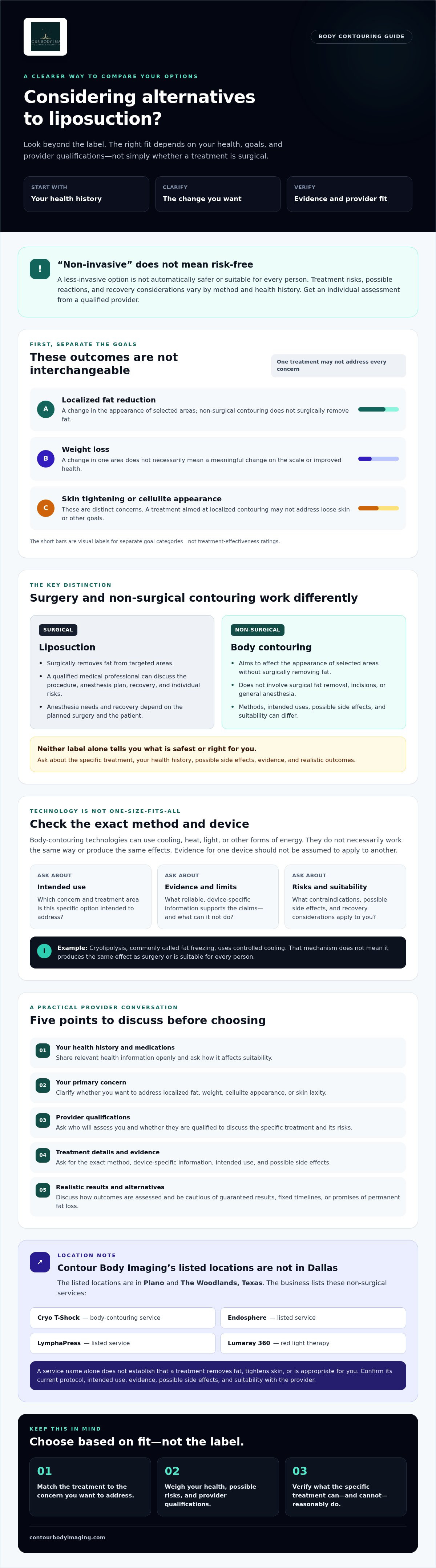
Non-surgical body contouring refers to treatments intended to affect the appearance of selected areas without surgically removing fat. That’s different from liposuction, which is a surgical procedure. The word “contouring” can also blur distinct goals: localized fat reduction, weight loss, a change in cellulite’s appearance, and skin tightening aren’t interchangeable outcomes. Ask which concern a specific treatment is intended to address and what evidence supports that use.
Safe alternatives to liposuction Dallas: what can contouring address?
These treatments are aesthetic options for selected concerns, not treatments for obesity or a replacement for broader health care. A change in the appearance of one area doesn’t necessarily mean a meaningful change on the scale, improved health, or tighter skin. Results and possible side effects vary by treatment and person. Ask what changes are realistic for your concern, what risks apply, and how outcomes are assessed. Be cautious of promises of guaranteed results, fixed timelines, or permanent fat loss.
How does liposuction differ from non-surgical treatment?
Liposuction is surgery that removes fat from targeted areas. An appropriately qualified medical professional can evaluate whether it may fit your goals and discuss the procedure, anesthesia plan, recovery, and individual risks. Anesthesia needs and recovery depend on the planned surgery and the patient. Surgical procedures also carry risks that should be explained during that evaluation.
Non-surgical options don’t involve surgical fat removal, incisions, or general anesthesia, but that doesn’t make every device or treatment appropriate or risk-free. Possible reactions and recovery considerations depend on the method and your health. For example, Cryolipolysis, commonly called fat freezing, uses controlled cooling. That mechanism doesn’t mean it produces the same effect as surgery or suits every person.
Liposuction surgically removes fat; non-surgical contouring aims to change the appearance of selected areas without surgically removing it. Before choosing either route, ask the provider to explain the treatment’s intended use, evidence, possible side effects, and alternatives in light of your health history.
How Non-Surgical Liposuction Alternatives Work, and What They Cannot Do
“Body contouring” covers different technologies and goals, not one treatment with a single mechanism. Some devices use cooling, heat, light, or other forms of energy. Their intended uses, evidence, possible side effects, and suitability can differ. The FDA’s overview of non-invasive body contouring explains that these technologies have specific intended uses and limitations. Check information for the exact device and treatment area rather than assuming evidence for one applies to another.
Don’t assume these treatments remove excess skin. If loose or hanging skin is your main concern, ask a qualified medical professional to assess it and explain which options may address it. A treatment aimed at localized contouring may not resolve skin laxity. Claims about how a device works or what it can achieve should be supported by reliable, device-specific information.
What should readers know about energy-based contouring?
Cooling-based treatments, radiofrequency, and other energy-based approaches are distinct categories. They don’t necessarily work in the same way or produce the same effects. Contour Body Imaging lists Cryo T-Shock as a non-invasive body-contouring service, but the available service information doesn’t establish its precise mechanism, device-specific evidence, or appropriate treatment areas. Ask the provider to explain the current protocol, intended use, contraindications, and possible side effects before deciding.
When might lymphatic or skin-focused services be relevant?
Contour Body Imaging also lists Endosphere therapy, LymphaPress, and Lumaray 360 red light therapy. The service names alone don’t establish that a treatment removes fat, tightens skin, or improves cellulite. Lymphatic-focused services aren’t liposuction or proven substitutes for surgical fat removal. Ask what concern each service is intended to address and what evidence supports that claim. If excess skin is the issue, get a separate clinical assessment rather than assuming a body-contouring or red-light service will address it.
Before booking any of the safe alternatives to liposuction Dallas readers may be comparing, ask which exact device will be used, what its intended use is, and where you can review its safety information. Confirm that the provider has considered your health history and can describe realistic outcomes without promising a particular result. Review Contour Body Imaging’s listed services, then bring questions about suitability and treatment scope to a qualified provider.
Liposuction vs. Non-Surgical Alternatives: Compare Safety, Goals, and Recovery
Neither approach is automatically right for everyone. Use this comparison to prepare questions, not to rank treatments. The appropriate option depends on your goals, health history, and an assessment by a qualified professional.
Non-surgical contouring and liposuction are different approaches, not interchangeable procedures. The American Society of Plastic Surgeons’ overview of nonsurgical fat reduction options can help explain the range of approaches. Claims should still be checked against evidence for the specific treatment being considered.
Which option fits localized fat, cellulite, or skin concerns?
Be specific about the change you want. For a localized bulge, ask whether the proposed treatment is intended for that concern and what results are realistic. For cellulite, ask about changes in its appearance. For loose skin, ask whether skin laxity needs a separate clinical assessment. Contour Body Imaging lists Cryo T-Shock body contouring and Endosphere therapy, but those service names alone don’t establish which concern either may address for you.
How should you compare risks and evidence?
Ask to review the exact device and treatment protocol, relevant evidence for your intended treatment area, possible side effects, and reasons it may not be suitable. Find out who evaluates and performs the treatment, what qualifications and training apply, and whom to contact if you have a concern afterward. Treat broad promises as a reason to ask for evidence, not as proof of a likely result.
For people comparing safe alternatives to liposuction Dallas providers may offer, a careful discussion of goals, risks, and evidence is more useful than choosing by a treatment label alone.
How to Choose a Safer Body-Contouring Option Near Dallas
A careful choice starts with your goal, not a device name or a promise. Use this process to organize the conversation and decide whether an option makes sense for your circumstances.
Define what you want to address. Describe the area and the change you hope to see. Clarify whether your concern is localized fat, cellulite’s appearance, loose skin, or weight, since these goals may call for different discussions.
Review your health history. Tell the provider about health conditions, medications, pregnancy or the possibility of pregnancy, allergies, and prior procedures in the area. Ask whether any of these could affect suitability. If you’re unsure, seek medical advice before proceeding.
Check the provider’s qualifications. Ask who will assess you and who will perform the treatment, what relevant training they have, and what clinical oversight applies. For medical-professional credentials, use official Texas Medical Board resources where applicable and verify the provider’s details directly.
Compare evidence and risks. Ask for information about the exact device and protocol, the intended treatment area, possible adverse effects, alternatives, and what evidence supports the expected outcome. A general claim about a treatment category doesn’t establish that a particular device is appropriate for you.
Decide without pressure. Request clear information about session planning and follow-up, but don’t assume there’s a standard course for everyone. Take time to compare options and ask for medical input if your health history raises questions.
What questions should you ask before booking?
Ask: “What is this treatment intended to address, and what would be a realistic outcome for me?” Also ask about contraindications, discomfort, side effects, aftercare, and when to seek medical help. Confirm whom you should contact if you have a concern after treatment. You can request a written plan explaining the proposed sessions and follow-up without assuming a particular number or schedule.
How can Dallas-area readers assess location and fit?
Confirm the clinic’s current address and travel distance before scheduling. Contour Body Imaging lists locations in The Woodlands and Plano, Texas, not Dallas, so check whether either location works for you. For more background, look for the guide titled Non-Invasive Body Sculpting: The Complete Guide to Results Without Surgery. Use it as general education, not a substitute for a personalized assessment.
These steps can help you compare safe alternatives to liposuction Dallas providers may offer, with clearer expectations and better questions. Choose a provider who welcomes discussion of your goals, health history, and the limits of the treatment.
Explore Non-Surgical Body Contouring at Contour Body Imaging
Once you’ve compared treatment goals and identified questions to ask, explore the non-surgical services listed by Contour Body Imaging. The clinic offers Cryo T-Shock body contouring, Endosphere therapy, LymphaPress, and Lumaray 360 red light therapy. These services have different purposes and shouldn’t be treated as interchangeable or equivalent to liposuction. The clinic does not offer surgery or weight-loss treatment.
Which Contour Body Imaging services might be relevant to your goals?
If you’re considering Cryo T-Shock, ask about the current protocol, which concerns it is intended to address, what evidence applies to that specific treatment, and whether it may suit your health history. The clinic lists Endosphere and LymphaPress as lymphatic-focused services. They are not surgical fat-removal procedures or proven substitutes for liposuction. Lumaray 360 is listed as a red light therapy service, so clarify its intended use as well. For more background, see the guide Cryo T-Shock Body Contouring: The Ultimate Guide to Non-Invasive Slimming in 2026, then confirm current details directly with the clinic.
What is a sensible next step for Dallas-area readers?
Contour Body Imaging’s listed locations are in Plano and The Woodlands, not Dallas. Check the current addresses, travel distance, and availability before making plans. Ask whether the service you’re considering aligns with your goal, what side effects or contraindications to discuss, and who can answer questions about suitability. If you have a health condition, take medication, are pregnant, or have had a prior procedure, consult an appropriate medical professional about whether treatment is suitable. The clinic’s service information is not a medical diagnosis or a substitute for personalized medical advice.
For readers comparing safe alternatives to liposuction Dallas options, a low-pressure conversation can clarify what a service is designed to do and what it cannot promise. Review the details and decide whether the location and treatment fit your needs.
Choose Your Next Step With Clear Expectations
The right choice isn’t determined by a treatment label. As you compare safe alternatives to liposuction Dallas providers may offer, focus on your goals, health history, the specific treatment’s evidence, and the qualifications of the person assessing you. Non-surgical contouring and liposuction are different approaches, and neither is suitable for everyone.
Before deciding, ask what concern a treatment is intended to address, what results are realistic, and what side effects, aftercare, or follow-up may apply. Contour Body Imaging lists non-surgical services including Cryo T-Shock body contouring, Endosphere, and LymphaPress. Its listed locations are in Plano and The Woodlands, Texas, not Dallas, so confirm the current location and availability before planning a visit.
Take your time, ask questions, and choose a next step that feels informed and appropriate for your needs. To discuss the clinic’s listed services and locations, contact Contour Body Imaging.
Frequently Asked Questions
Are non-surgical alternatives to liposuction safer?
Not necessarily. Risk depends on the specific treatment, the provider’s qualifications, and your individual health. Non-surgical procedures avoid surgery, but they can still have side effects or be unsuitable for some people. Ask what risks apply to the exact device and protocol, who will assess and perform the treatment, and how your medical history affects candidacy. A qualified provider can help you compare risks without labeling any option risk-free.
Can non-surgical body contouring produce the same results as liposuction?
No. They are different procedures and shouldn’t be expected to produce identical results. Liposuction surgically removes fat from targeted areas, while non-surgical treatments use different methods and have specific intended uses. Outcomes can vary by treatment, treated area, and individual. Before choosing, clarify whether your goal is localized fat reduction, a change in cellulite’s appearance, or skin tightening. Then ask what results are realistic for that concern.
What is the safest alternative to liposuction for localized fat?
There isn’t one universally safest choice for localized fat. The right option depends on your health history, the area you want to address, and the specific treatment’s risks, evidence, and intended use. Ask a qualified provider to assess whether you’re a suitable candidate and explain alternatives, possible side effects, and realistic outcomes. If a treatment is presented as guaranteed or appropriate for everyone, ask for more detail before deciding.
Can Cryo T-Shock replace liposuction?
No. Contour Body Imaging lists Cryo T-Shock Body Contouring as a non-surgical service, while liposuction is surgery that removes fat. They are different approaches, so Cryo T-Shock shouldn’t be assumed to match liposuction’s effects or results. Ask the clinic about its current treatment protocol, intended use, potential side effects, and whether it may suit your goals and health history. A provider can help set realistic expectations.
Who should avoid non-surgical body contouring?
It depends on the treatment, since contraindications can differ by device and protocol. A health condition, medication, pregnancy, or a prior procedure may affect whether a particular option is appropriate, but no general list can determine your personal suitability. Share your full health history with a qualified provider and ask whether you should first seek advice from your medical professional. Don’t proceed until your questions about risks and candidacy are answered.
Where can I find non-surgical body contouring near Dallas?
Contour Body Imaging lists locations in The Woodlands and Plano, Texas, rather than Dallas. Its listed services include Cryo T-Shock body contouring, Endosphere, and LymphaPress. Confirm current clinic addresses, availability, and travel distance directly before making plans. If you’re comparing providers in the Dallas area, also check who evaluates and performs each treatment, what qualifications apply, and whether the service matches your goals.
How many sessions do non-surgical fat-reduction treatments require?
There’s no single session count that applies to every treatment or person. Protocols may depend on the specific device, treatment area, intended goal, and provider’s assessment. Before committing, ask how a proposed plan is determined, whether follow-up is recommended, and how progress will be evaluated. Request clear information about expected scheduling and any additional sessions, but be cautious of claims that promise a fixed course or guaranteed outcome.


Comments