

Red Light Therapy in Plano, TX: Benefits, Expectations, and Your Next Steps

What should you expect from red light therapy beyond the bold claims? If you’re exploring red light therapy Plano TX, it helps to understand how light-based wellness services work, what they may support, and how to decide whether a session fits your goals.
Contour Body Imaging offers Lumaray 360 red light therapy at its Plano and The Woodlands locations. The service is described as supporting cellular repair and overall skin health. It is a wellness option, not a guaranteed result or a substitute for medical care. This guide explains the basics, outlines what to consider before a session, and puts research and limitations in context so you can make an informed choice.
Table of Contents
Red Light Therapy in Plano, TX: What It Is and What It May Support
If you’re searching for red light therapy Plano TX, you may be trying to distinguish a wellness service from medical treatment. Contour Body Imaging offers Lumaray 360 as a red light therapy service. Its stated focus is supporting cellular repair and overall skin health. It is not intended to diagnose or treat a health condition.
How does red light therapy work at a basic level?
Red light is visible light at the red end of the spectrum. Near-infrared light sits just beyond the visible range, so people generally can’t see it. Devices may use red light, near-infrared light, or both, and their design and output can vary. Red light is distinct from ultraviolet light, which has shorter wavelengths and different effects on the body. That distinction does not mean every red light device works the same way or is suitable for every person.
In photobiomodulation, light is directed at the body with the aim of prompting a response in cells. Researchers study how this process may work, but proposed mechanisms and outcomes depend on the device and the use being studied. For a general overview of the field, see Low-level laser therapy, also known as photobiomodulation. The practical point is that light exposure describes the method, not proof of a particular result.
What can readers reasonably expect it to support?
Contour Body Imaging presents Lumaray 360 as supporting cellular repair and overall skin health. These are wellness and skin-focused goals, not a promise that everyone will notice the same effect. Before booking, identify what you hope to support and consider whether the service’s stated focus matches that goal. A wellness service can be one part of personal self-care, but it isn’t a substitute for individualized medical advice.
Some people explore light-based services because they’re interested in joint comfort. Interest isn’t the same as evidence that a wellness session can diagnose or treat joint pain. Persistent, worsening, or unexplained joint symptoms deserve guidance from a qualified healthcare professional, who can help assess their cause and discuss appropriate care.
In short: red light therapy is a wellness service involving light exposure, while medical care for joint pain addresses symptoms and their possible causes. Knowing the difference can help you decide whether Lumaray 360 aligns with your wellness goals, without expecting it to replace clinical evaluation or guarantee an outcome.
Red Light Therapy for Joint Comfort: Evidence, Limits, and Realistic Expectations
Research on red light therapy and joint comfort needs to be read in context. Findings about one condition, device, or protocol don’t automatically show that every red light service will have the same effect. That distinction matters when weighing wellness marketing against clinical evidence.
What does research say about red light therapy and joint pain?
A 2019 systematic review and meta-analysis by Stausholm and colleagues in BMJ Open examined low-level laser therapy for pain associated with knee osteoarthritis. The authors reported potential pain benefits in the trials they analyzed, but the research focused on a specific condition and laser protocols, not general joint comfort or every light-based device. Differences among study methods and treatment settings also limit how broadly the results can be applied.
A finding about knee osteoarthritis, then, isn’t proof that a wellness session addresses other joint symptoms. Photobiomodulation studies use defined equipment, exposure parameters, conditions, and outcomes. Those details may not match Lumaray 360, and the research doesn’t establish a result for an individual session. Red light therapy is not a substitute for medical evaluation.
Which expectations should you keep realistic?
There’s no reliable way to know from one session whether you’ll notice a benefit. Responses can vary with the device and its protocol, the individual, and the outcome being measured. A study may assess pain scores over a set period, while someone considering a wellness service may have a different goal. Those measures aren’t interchangeable, and research findings shouldn’t be turned into promises of pain reduction, healing, or a particular timeline.
If you have persistent, worsening, or unexplained joint symptoms, seek individualized advice from a qualified healthcare professional. Don’t stop medication, rehabilitation, or other clinician-directed care because of a red light therapy claim. For general wellness, keeping that boundary clear can help you assess red light therapy Plano TX with realistic expectations.
Contour Body Imaging offers Lumaray 360 as a wellness-focused service, not as a treatment for joint conditions. If its stated focus on cellular repair and overall skin health aligns with your goals, you can explore Lumaray 360 red light therapy.
Choosing a Red Light Therapy Session in Plano: Questions That Matter
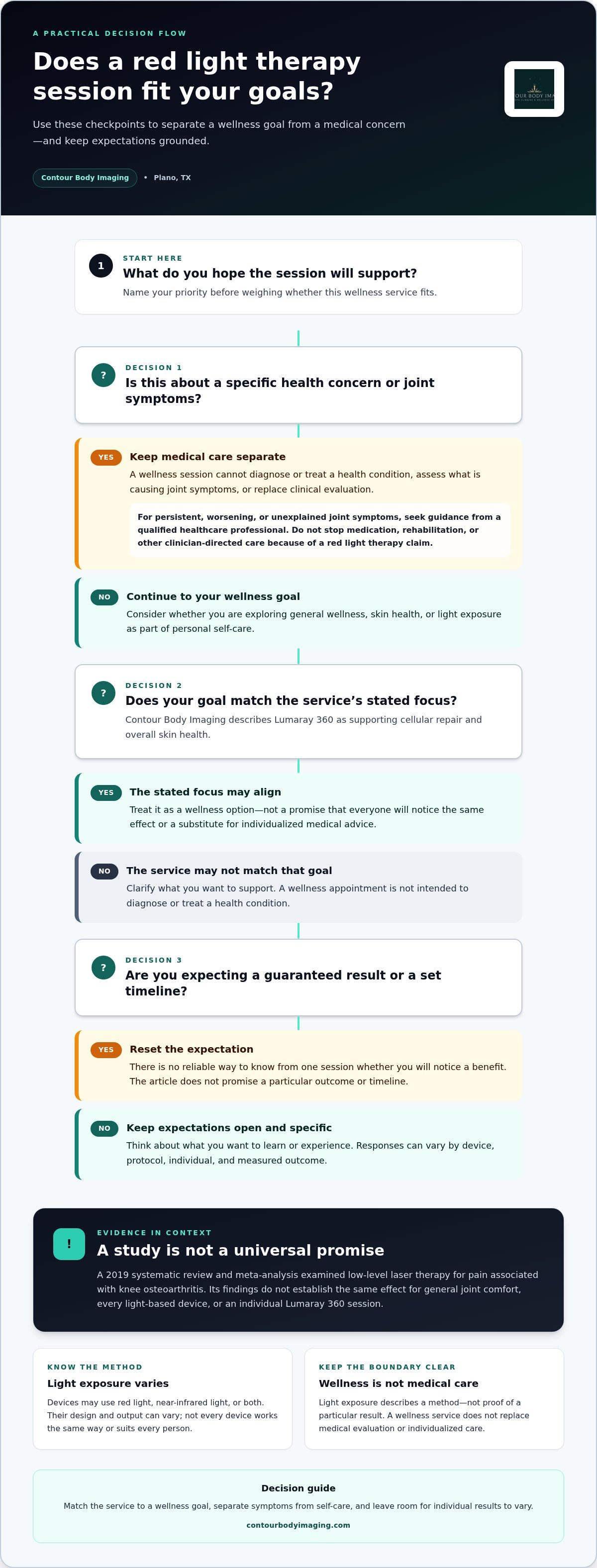
Choosing red light therapy Plano TX starts with a simple question: what do you hope the session will support? A clear goal helps you decide whether a wellness-focused service suits you, without expecting it to take the place of medical care or deliver a guaranteed result.
How do you decide whether a session fits your goals?
Before booking, decide whether you’re interested in general wellness, skin health, or exploring light exposure as part of your personal self-care routine. If joint comfort is on your mind, keep that separate from a medical treatment goal. A wellness appointment can’t assess what’s causing joint symptoms or replace a clinical evaluation.
Use this short checklist to clarify what matters to you:
Name your priority. Are you exploring a wellness experience or hoping to address a specific health concern?
Set a realistic measure of success. Think about what you want to learn or experience, rather than assuming a particular physical result.
Consider your comfort. Review the service description and note any comfort needs you want to discuss before your session.
Understand the scope. Keep wellness goals distinct from diagnosis, treatment, and clinician-directed care.
These questions help you compare services by how well they fit your preferences and goals, rather than by broad claims. If you have persistent or worsening joint symptoms, seek guidance from a qualified healthcare professional before treating a wellness session as relevant to your care.
What should you understand about the Lumaray 360 service?
Lumaray 360 is Contour Body Imaging’s red light therapy offering. The clinic describes its focus as supporting cellular repair and overall skin health. That description explains the service’s wellness focus, not a promised outcome for every person. Use it to judge whether the service aligns with what you’re looking for.
Session details can vary by service protocol, so don’t assume a specific duration, schedule, or response. A thoughtful choice means understanding the service’s purpose and feeling comfortable with its expectations. You can also explore the clinic’s guide to non-invasive wellness for a broader look at its approach.
What to Expect Before, During, and After Red Light Therapy
A first red light therapy session is easier to approach when you know what you want to ask and what not to assume. For red light therapy Plano TX, the details of a Lumaray 360 visit depend on the service protocol. Generic claims about timing, preparation, or what you’ll feel may not apply. Use the appointment to understand the experience and decide whether it suits your wellness goals.
Before your appointment
Think about why you’re considering a session. You might be interested in general wellness or skin health, or simply want to understand what the service involves. Note any comfort concerns or questions you’d like addressed. Follow the appointment instructions for your visit rather than assuming every light-based service has the same preparation steps.
If you have a health concern, a medical condition, or symptoms you’re hoping to address, consult an appropriate healthcare professional about your situation. A wellness appointment isn’t a clinical assessment and shouldn’t replace evaluation of joint symptoms or other health issues.
During the session
Expect to learn how the service is carried out and what the appointment involves. The setup and duration depend on the protocol, so don’t infer them from descriptions of other devices or services. Ask for an explanation before proceeding if anything is unclear.
Your comfort matters. Share concerns or questions during the visit, and speak up if you feel uncomfortable. Clear communication helps you make an informed choice about the experience.
After the session
Notice how you feel, but don’t treat one visit as proof that the service has or hasn’t produced a particular outcome. Responses differ, and immediate or lasting changes aren’t guaranteed. If you’re tracking a personal wellness goal, make a simple note of your experience and keep expectations grounded. Don’t change clinician-directed care based on a wellness session.
A measured approach is straightforward: arrive with your goals in mind, understand the service before starting, communicate during the visit, and give yourself room to decide what feels right afterward.
Explore Lumaray 360 Red Light Therapy at Contour Body Imaging
If you’re considering red light therapy Plano TX, Lumaray 360 is a wellness-focused option at Contour Body Imaging, with locations in Plano and The Woodlands, Texas. It may interest people looking to explore light-based wellness or support skin health, provided expectations stay realistic. A session isn’t a guaranteed result or a substitute for medical evaluation and care, especially if you’re dealing with ongoing joint symptoms.
How does red light therapy fit into a broader wellness plan?
Lumaray 360 is one option within the clinic’s broader non-invasive wellness services. You can consider it on its own or alongside other services that match separate personal goals. There’s no need to combine treatments to make a red light therapy session meaningful. The right choice depends on what you’re hoping to support and what feels appropriate for you.
For example, someone exploring skin-focused services may also want to learn about Cryo Facial benefits and skin wellness. That service has its own purpose and shouldn’t be confused with red light therapy. If you have a health concern, keep appropriate healthcare in the picture rather than relying on a wellness appointment to assess or manage it.
Contour Body Imaging describes Lumaray 360 as supporting cellular repair and overall skin health. These are the service’s stated wellness focuses, not promises of a particular response. Your experience may differ, and an individual session can’t guarantee a specific change.
What is a sensible next step for Plano clients?
Start by reviewing the Lumaray 360 service information and comparing its stated focus with your own goals. Consider what you’d like to understand before a visit, such as what the appointment involves and how to communicate your comfort needs. The aim is to make a considered choice, not to feel committed to a particular outcome or treatment plan.
If the service sounds aligned with your wellness interests, explore the clinic’s information and decide whether booking feels like the right next step. Clients in Plano and The Woodlands can consider Lumaray 360 alongside Contour Body Imaging’s other non-invasive services.
Take Your Next Step With Clear Expectations
Understanding red light therapy Plano TX starts with knowing what it may support and what it can’t promise. Lumaray 360 is Contour Body Imaging’s red light therapy service, described as supporting cellular repair and overall skin health. Research on joint symptoms is specific to the conditions and protocols studied, so it shouldn’t be treated as a guarantee or a replacement for medical evaluation.
Before considering a session, identify your wellness goals, review the service information, and note any comfort questions you’d like to discuss. Contour Body Imaging serves clients in Plano and The Woodlands, Texas, with Lumaray 360 among its non-invasive wellness options.
Choose at your own pace. A clear goal and realistic expectations can help you decide whether Lumaray 360 fits your wellness routine. Explore the service at Contour Body Imaging in Plano or The Woodlands.
Frequently Asked Questions
Does red light therapy help with joint pain?
Red light therapy hasn’t been established as a reliable treatment for everyone with joint pain. Research has examined photobiomodulation for specific conditions, including knee osteoarthritis, using defined devices and protocols. Those findings don’t guarantee that a wellness session will ease pain or apply to other joint concerns. If your symptoms persist, worsen, or are unexplained, consult a qualified healthcare professional rather than relying on a wellness service for diagnosis or treatment.
Is red light therapy safe for everyone?
No single light-based service is necessarily suitable for everyone. Devices and protocols differ, and personal health circumstances can affect whether an appointment is appropriate. If you have a health condition, take medication, are pregnant, or have concerns about light exposure, speak with an appropriate healthcare professional before proceeding. During a wellness visit, share relevant comfort concerns and ask for an explanation of the service. Don’t assume that another device’s safety guidance applies to Lumaray 360.
How does red light therapy work?
Red light therapy involves exposing the body to red light, and some devices also use near-infrared light. The approach, often discussed as photobiomodulation, is studied for how light exposure may prompt cellular responses. Proposed mechanisms and outcomes depend on the equipment and how it’s used, so they shouldn’t be treated as proof of a specific result. Red light is different from ultraviolet light, and devices aren’t all identical in design or output.
What should I expect during a red light therapy session in Plano?
The service experience depends on the provider’s protocol and the device used. For a Lumaray 360 appointment, don’t assume a particular duration, sensation, or preparation routine based on descriptions of other services. Review the appointment instructions, arrive ready to discuss your goals and comfort needs, and speak up if you have questions or feel uncomfortable. One visit can’t guarantee immediate or lasting changes, and responses vary.
How many red light therapy sessions do people need?
There isn’t one session count that applies to every person or every red light service. Research protocols may involve repeated sessions, but schedules depend on the device, the condition studied, and the outcome being measured. Those research schedules don’t automatically establish a plan for Lumaray 360 or guarantee a benefit. Review the service information and keep expectations realistic. Don’t commit to a routine based on a promised result or a schedule from an unrelated device.
Can red light therapy replace treatment from a doctor or physical therapist?
No. A wellness session isn’t a substitute for assessment or care from a qualified healthcare professional, including a doctor or physical therapist. It can’t diagnose the cause of joint pain or replace medication, rehabilitation, or other clinician-directed care. If you’re exploring light exposure for general wellness, keep it separate from medical treatment goals. Talk with your healthcare professional about persistent or worsening symptoms, and don’t change prescribed care because of a marketing claim.
Is Lumaray 360 available at Contour Body Imaging in Plano?
Yes. Contour Body Imaging offers Lumaray 360 red light therapy in Plano and The Woodlands, Texas. The service is described as supporting cellular repair and overall skin health, without a guaranteed response for every person. If you’re researching red light therapy Plano TX, review the service information to see whether its wellness focus aligns with your goals. Appointment details depend on the service protocol.


Comments