

Cryotherapy for Collagen Production: What the Science Says
Can a blast of cold really help your skin make more collagen, or does a cryo facial mainly create a short-lived glow? It’s a fair question: beauty claims can sound certain even when the science is still developing. The idea behind cryotherapy for collagen production is biologically plausible, but plausibility isn’t proof of lasting firmness or fewer wrinkles.
Collagen helps give skin structure and support, so it’s understandable to look for ways to maintain it. Early research on cold-based skin treatments is promising, but stronger, longer-term evidence is needed to show whether they meaningfully change collagen levels or skin firmness. In this article, you’ll learn how collagen is produced, what researchers say about cryotherapy’s possible effects, and how to distinguish temporary changes in appearance from structural ones. We’ll also cover practical questions to ask about a professional cryo facial, including how the treatment works, what risks to consider, and whether it suits your skin goals. That way, you can assess claims and make a more informed choice.
Table of Contents
What Does Cryotherapy for Collagen Production Mean for Skin?
How Could Cold Exposure Relate to Collagen and Skin Response?
Does Cryotherapy Increase Collagen? Evidence, Expectations, and Limits
How to Consider a Cryo Facial Safely and Set Realistic Goals
Choosing a Cryo Facial for Collagen Goals in The Woodlands or Plano
What Does Cryotherapy for Collagen Production Mean for Skin?
Cryotherapy alone doesn’t prove that skin produces more collagen or undergoes a lasting cosmetic change. The phrase cryotherapy for collagen production refers to a proposed relationship between cold exposure and the skin’s response, not a guaranteed or established outcome. To assess the claim fairly, start by understanding what collagen does and what “cryotherapy” can mean in different settings.
The term covers a range of cold-based approaches, from cosmetic facial services to whole-body exposure and medical uses. The general Cryotherapy overview describes this variety, but it doesn’t establish that a particular facial method changes collagen in human skin.
What collagen does in the skin
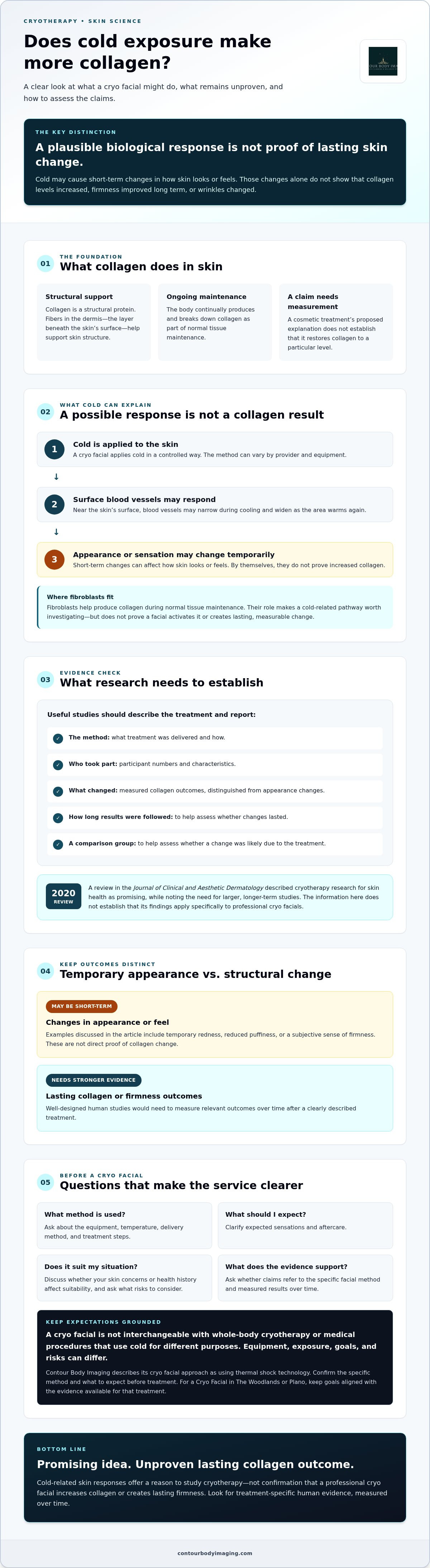
Collagen is a structural protein. In the dermis, the layer beneath the skin’s surface, collagen fibers help provide support and contribute to the skin’s structure. The body continually produces and breaks down collagen as part of normal tissue maintenance. That balance can change over time and is influenced by biological and environmental factors.
This normal process doesn’t mean a cosmetic treatment can restore collagen to a specific level. Claims about increased production need evidence that measures collagen changes in people, not just a proposed explanation or a short-term change in how skin looks or feels.
What cryotherapy means in a facial setting
A cryo facial is a cosmetic service that applies cold to the face in a controlled way. The method can vary by provider and equipment, so the name alone doesn’t tell you the temperature, delivery method, or treatment steps. Ask the provider to explain exactly what they use. Contour Body Imaging offers Cryo Facials and describes its approach as using thermal shock technology. Confirm the specific method and what to expect before treatment.
A facial service is not interchangeable with whole-body cryotherapy or medical procedures that use cold for different purposes. Those approaches can involve different equipment, exposure, goals, and risks. Don’t assume evidence or safety information for one type applies to another. A guide to cryo facial benefits can offer a general overview, but check whether the claims match the specific treatment and available evidence.
A proposed mechanism explains how a treatment might work; only well-designed human studies can show whether it produces a meaningful, lasting skin outcome. Keeping that distinction in mind helps you consider collagen claims without dismissing potential effects or mistaking a theory for proof.
How Could Cold Exposure Relate to Collagen and Skin Response?
Cold prompts a physical response in the skin, but that response isn’t proof of increased collagen. Blood vessels near the skin’s surface may narrow during cooling and widen as the area warms again. These short-term changes can affect circulation and how skin looks or feels, but they don’t, on their own, show that the skin has made more collagen.
Fibroblasts are cells in the skin that help produce collagen as part of normal tissue maintenance. They’re relevant to the theory behind cryotherapy for collagen production, but naming a possible cellular pathway doesn’t prove that a facial treatment activates it or leads to measurable, lasting changes. Researchers would need to measure collagen-related outcomes in people after a clearly described treatment.
What research would need to show
Useful evidence would identify the treatment method, the number and characteristics of participants, the outcomes measured, and how long researchers followed participants. It would also distinguish direct collagen measurements from changes in appearance, such as temporary redness, reduced puffiness, or a subjective sense of firmness. A comparison group helps researchers assess whether an observed change is likely due to the treatment.
A 2020 review in the Journal of Clinical and Aesthetic Dermatology described cryotherapy research for skin health as promising, while noting the need for larger, longer-term studies. The information available here doesn’t establish the review’s sample sizes or show that its findings apply specifically to professional cryo facials. That limits what readers can conclude about facial collagen outcomes.
Current evidence may support further study of cold-based skin treatments, but it doesn’t establish that a professional cryo facial produces lasting collagen increases. A plausible explanation is a reason to investigate, not confirmation of a cosmetic result.
Why different cryotherapy treatments aren’t interchangeable
“Cryotherapy” describes approaches that can differ substantially. A professional cryo facial applies cold to the face using a provider-specific method. Whole-body cryotherapy exposes much more of the body, while cold plunges involve immersion. Cryoablation uses cold to destroy targeted tissue for medical purposes. Differences in equipment, temperature, exposure time, and treated body area mean results from one approach can’t automatically be applied to another.
For a specific cryo facial, ask what method is used and whether any evidence cited relates to that exact approach. If you’re considering a Cryo Facial from Contour Body Imaging, you can ask about its facial treatment and discuss whether it aligns with your goals. Keep questions about facial skin separate from body-contouring treatments, which have different purposes.
Does Cryotherapy Increase Collagen? Evidence, Expectations, and Limits
The clearest answer is that cryotherapy may have a plausible biological connection to collagen, but current evidence doesn’t establish that a professional cryo facial reliably increases collagen or creates lasting skin changes. A 2020 review in the Journal of Clinical and Aesthetic Dermatology described cryotherapy research for skin health as promising while noting that larger, longer-term studies are needed. That cautious finding doesn’t confirm a specific collagen benefit from every facial treatment.
Separate what you notice immediately from what a study would need to demonstrate. Skin may feel refreshed or look temporarily less puffy or more toned. Those impressions can matter when choosing a cosmetic service, but they don’t measure collagen. Evidence for a structural change would need to assess collagen-related outcomes, fine lines, or firmness over time, using a defined facial method and a suitable comparison.
Temporary skin effects versus lasting changes
A brief change in skin sensation or appearance isn’t a reliable marker of new collagen. Without service-specific evidence, there’s no sound basis to promise a particular degree of improvement, timeline, or duration. If you decide to try a treatment, discuss your goals and expectations with the provider. For a more useful personal comparison, take photos in similar lighting and conditions, and don’t treat a single post-treatment impression as a long-term result.
How to interpret collagen claims responsibly
Ask whether a claim comes from independent, published human research on the same device or method and facial application, or from a provider’s description of the treatment. The distinction matters: Contour Body Imaging describes its Cryo Facial as supporting collagen production, but that service description isn’t the same as independent clinical evidence. The evidence summarized here also doesn’t establish that a cryo facial is equivalent to dermatological procedures with different methods and research. Treat cryotherapy for collagen production as a claim to evaluate, not a guaranteed outcome.
How to Consider a Cryo Facial Safely and Set Realistic Goals
A thoughtful conversation before treatment can help you understand what to expect and decide whether a cryo facial fits your skin goals. Use this checklist to get clear answers. Methods and precautions can vary, so don’t assume every service called a “cryo facial” works the same way.
Questions to ask before booking
Clarify your goal. Are you hoping for a temporarily refreshed appearance, or expecting a lasting change in fine lines or firmness? Ask what the treatment can reasonably address and what it can’t promise.
Ask exactly what the facial involves. What device or method is used? How is the temperature controlled, and which areas of the face are treated? Ask the provider to explain the steps in plain language.
Discuss sensations and possible side effects. What might the cold feel like during treatment, and what skin reactions could occur afterward? Ask what aftercare is recommended and when you should seek medical advice about a reaction.
Ask what supports the claims. If collagen production or fine-line reduction is part of the explanation, ask whether evidence comes from human research on the same method and facial application. A proposed mechanism or provider description isn’t the same as demonstrated results.
Agree on follow-up and expectations. Ask how progress should be assessed and when to check in about your response. Don’t rely on an assumed timeline or a single immediate impression to judge lasting change.
Share relevant skin and health information
Before treatment, tell the provider about skin sensitivity, current skin concerns, relevant health conditions, and skincare treatments you’re using or have recently had. This can help them discuss whether the procedure is appropriate and whether any precautions apply. Suitability depends on both the individual and the specific cold-based method.
If you have a condition that may affect your response to cold, ask a healthcare professional for individualized guidance before proceeding. A provider can explain the service, but this article and a cosmetic appointment aren’t substitutes for personalized medical advice or diagnosis.
For cryotherapy for collagen production, keep expectations grounded: ask what the treatment is designed to do, what evidence supports that claim, and how your own response will be discussed. In The Woodlands or Plano, you can ask Contour Body Imaging about its Cryo Facial and the treatment details before deciding whether it aligns with your goals.
Choosing a Cryo Facial for Collagen Goals in The Woodlands or Plano
If you’re considering a local cryo facial, use a simple decision framework: define the skin change you’re hoping for, check what evidence supports the claims, ask exactly how the treatment is performed, and confirm whether it’s suitable for you. This keeps the focus on your needs rather than broad promises about collagen or wrinkle reduction.
What to look for in a local cryo facial provider
A provider should be able to explain the treatment process clearly, including the method used, areas treated, expected sensations, and relevant precautions. Ask what results are realistic for your goal and whether claims about collagen or fine lines are supported by human research on that specific facial method. If the evidence is limited or doesn’t match the treatment being offered, a straightforward answer helps you make an informed choice.
Suitability is individual. Share relevant skin concerns and health information, then ask how these factors affect the treatment recommendation. You should feel comfortable asking questions and taking time to decide. For broader background on local skincare options, readers can also consult an aesthetic clinic in The Woodlands guide, if available on the site.
A low-pressure next step with Contour Body Imaging
Contour Body Imaging offers a Cryo Facial at its locations in The Woodlands and Plano, Texas. The clinic describes the service as using thermal shock technology and supporting collagen production, but that description shouldn’t be taken as a guarantee of increased collagen, fewer fine lines, or lasting skin firmness. Ask for an explanation of the specific method, what to expect, and how the team considers your goals and individual concerns before you decide.
If you’d like a general overview before speaking with a provider, look for the clinic’s Cryo Facial Benefits guide. Reviewing it alongside your questions can help you distinguish the service’s intended benefits from outcomes that research has firmly established.
If you’re exploring cryotherapy for collagen production, the most useful next step is a clear, pressure-free discussion about fit and expectations. If you’re near The Woodlands or Plano, contact Contour Body Imaging to ask about its Cryo Facial and whether it may align with your skin goals.
Make Your Next Skin-Care Choice With Confidence
Cold exposure can trigger a skin response, but that response alone doesn’t prove increased collagen or lasting changes in firmness. The science behind cryotherapy for collagen production remains promising but limited, so look for evidence on the specific facial method rather than relying on broad claims. A refreshed appearance may be a welcome short-term effect, but it isn’t the same as a measured structural change.
Before choosing a treatment, clarify your goal, ask how the facial works, and discuss realistic outcomes, precautions, and your personal skin concerns with the provider. These questions can help you make a considered choice without expecting guaranteed wrinkle reduction or collagen gains.
Contour Body Imaging offers Cryo Facials in The Woodlands and Plano. Explore the service and ask questions before deciding whether it fits your goals.
Whatever you decide, informed expectations are a strong starting point for feeling comfortable and confident in your skin-care choices.
Frequently Asked Questions
Does cryotherapy increase collagen production?
It hasn’t been established that cryotherapy reliably increases collagen production in facial skin. Cold exposure may have a plausible relationship to the skin’s response, but a proposed mechanism isn’t proof of lasting change. A 2020 review in the Journal of Clinical and Aesthetic Dermatology described research on cryotherapy for skin health as promising while noting the need for larger, longer-term studies. Ask whether claims relate to human research on the specific facial treatment.
Can a cryo facial help with fine lines?
A cryo facial may be marketed for fine lines, but current evidence doesn’t establish that it produces lasting wrinkle reduction. Skin can look or feel different immediately after treatment, and that short-term impression isn’t proof of structural change. Before booking, ask what results are realistic, what evidence supports the claim, and whether it applies to the provider’s specific facial method. Don’t treat a promised outcome as guaranteed.
How does cryotherapy affect collagen in the skin?
Cold exposure can prompt a physiological response in the skin, but that response doesn’t automatically mean collagen levels change. Fibroblasts are cells involved in producing collagen, and researchers may study whether cold-based treatments influence collagen-related processes. To show a cosmetic benefit, human studies would need to measure relevant outcomes after a clearly described treatment and assess whether any change lasts. The proposed biology alone can’t confirm increased collagen.
Is a cryo facial the same as whole-body cryotherapy?
No. A cryo facial applies cold to the face using a method that can vary by provider. Whole-body cryotherapy exposes a much larger area, and other approaches, such as cold plunges or cryoablation, differ in purpose and procedure. Because the equipment, temperatures, exposure, and treated areas may differ, evidence about one approach shouldn’t automatically be applied to another. Ask the provider to explain exactly what their facial involves.
What should I ask before booking a cryo facial?
Ask what method and equipment the provider uses, how temperature is controlled, and which areas are treated. Find out what sensations or side effects to expect, what aftercare is recommended, and what evidence supports claims about collagen or fine lines. Share your skin concerns and health history, then ask how they affect suitability. Clarify how the provider will discuss your progress without promising a particular timeline or result.
Can everyone try cryotherapy for skin?
No single answer applies to everyone. Suitability and precautions depend on your health, skin concerns, and the particular cold-based procedure. Tell the provider about skin sensitivity, relevant health conditions, and current skincare treatments before deciding. If a health condition could affect your response to cold, seek individualized guidance from a healthcare professional first. General information about cryotherapy can’t determine whether a treatment is appropriate for you.
Where can I ask about a cryo facial near The Woodlands or Plano?
Contour Body Imaging offers Cryo Facials at its locations in The Woodlands and Plano, Texas. The clinic describes its facial service as using thermal shock technology. Ask the team about the treatment method, realistic expectations, precautions, and whether it may fit your skin goals. Keep questions about this facial separate from Cryo T-Shock Body Contouring, which is a distinct body service.


Comments