

CoolSculpting vs. Non-Invasive Contouring: Choosing the Right Technology in 2026
If you’re comparing CoolSculpting vs non-invasive contouring, you may be focused on a stubborn area that hasn’t changed with diet and exercise, while hoping to avoid surgery and a lengthy recovery. The best comparison starts with your specific goal: reducing a localized fat pocket, addressing skin texture, or considering both.
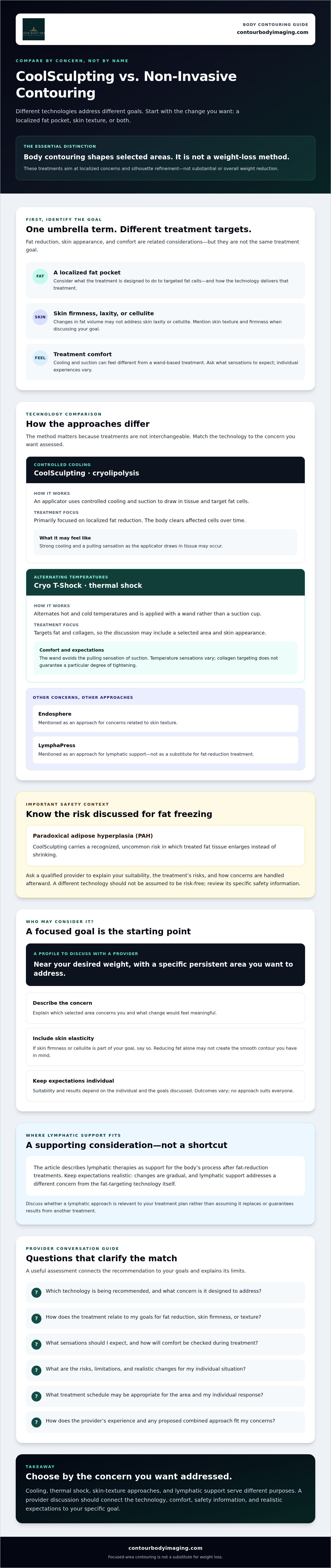
CoolSculpting uses controlled cooling to target fat cells. Cryo T-Shock uses alternating hot and cold temperatures to target fat and collagen, while Endosphere and LymphaPress address different concerns related to skin texture and lymphatic support. These approaches are not interchangeable, so it helps to understand what each treatment is designed to do before choosing.
Is fat freezing the right fit, or would another approach better match your goals and comfort preferences? This guide compares the technologies, explains what lymphatic therapies may contribute, and offers practical questions to ask a provider. Body contouring is intended to shape targeted areas, not replace weight loss.
Table of Contents
What is Non-Invasive Body Contouring in 2026?
Non-invasive body contouring uses external technologies to address selected areas without surgery or removing tissue. It is not a weight-loss method. The aim is to refine the silhouette by focusing on a localized concern rather than changing overall body weight. Fat reduction, skin appearance, and comfort are related considerations, but they are not the same treatment goal.
When weighing CoolSculpting vs non-invasive contouring, start by identifying what you want to change. Cryolipolysis, the process used in fat freezing, applies controlled cooling. Thermal shock alternates hot and cold temperatures. Ultrasound-based devices use focused sound energy to target tissue. These technologies work differently, so a treatment designed for one concern should not be assumed to address another. For a foundational overview of the cooling method, see Cryolipolysis.
The Evolution of Fat Reduction Technologies
Non-surgical body contouring includes more than one type of technology. Some treatments are designed to damage targeted fat cells, which the body processes gradually. This is different from lifestyle-related weight changes, which can affect fat-cell size. Non-invasive treatments are not equivalent to surgery and may be considered by people seeking localized refinement rather than substantial weight reduction. Outcomes vary.
Thermal shock takes a different route from sustained cooling by alternating hot and cold temperatures. Cryo T-Shock uses this thermal approach to target fat and collagen, so the treatment focus can include skin appearance as well as a selected area. Suitability and results depend on the individual and the goals discussed with the provider.
Who is the Ideal Candidate for Non-Invasive Sculpting?
These treatments are generally considered for someone near their desired weight who wants to discuss a specific, persistent area, rather than pursue broad weight reduction. Because treatment is directed at selected areas, be ready to describe the concern and what change would feel meaningful to you.
Skin elasticity is another consideration. If skin does not adapt as much as expected when volume changes, reducing fat alone may not produce the smooth contour you have in mind. Tell the provider if skin firmness or cellulite is part of your goal. Treatments that address collagen or skin texture may be relevant, but no approach suits everyone. A useful assessment connects the recommendation to your concerns and explains its limits.
CoolSculpting vs. Thermal Shock: Comparing the Science
CoolSculpting and thermal shock use different methods to address localized fat. CoolSculpting uses cryolipolysis, applying controlled cooling through an applicator that draws tissue in with suction. The treatment is designed to damage fat cells while leaving surrounding tissue relatively unharmed; the body then clears affected cells over time. A review of clinical data on cryolipolysis discusses the method’s evidence and safety considerations.
Thermal shock alternates hot and cold rather than relying on sustained cooling and suction. Cryo T-Shock uses this thermal approach to target fat and collagen. It is applied with a wand, not a suction cup, which may suit people who prefer to avoid a pulling sensation. Experiences of temperature and comfort vary, so ask the provider what to expect during treatment.
The Cryo T-Shock Advantage
Fat reduction and collagen support relate to different parts of a contouring goal. Cryo T-Shock’s alternating temperatures are intended to target both, while traditional fat freezing primarily focuses on fat reduction. This difference may matter if skin firmness is also a concern, but it does not guarantee a particular degree of tightening. Ask how the treatment relates to your goals and what changes would be realistic to expect.
CoolSculpting also carries a recognized, uncommon risk called paradoxical adipose hyperplasia (PAH), in which treated fat tissue enlarges instead of shrinking. Ask a qualified provider to explain this risk, your suitability, and how they handle concerns after treatment. A different technology should not be assumed to be risk-free. Review its specific safety information before deciding.
What to Expect During and After Treatment
With fat freezing, you may feel strong cooling and pulling as the applicator draws in tissue. Thermal shock uses a wand rather than suction. Contour Body Imaging describes Cryo T-Shock as pain-free, although individual sensations can vary. Ask the provider to explain the process, how comfort is checked, and what to do if you feel uncomfortable.
There is no universal session count or timeline for either treatment. The area, treatment plan, and individual response matter, so ask what schedule may be appropriate and when to assess changes. After cryolipolysis, results develop gradually as the body processes treated cells. For thermal shock, request expectations specific to your goals rather than relying on a guaranteed date or outcome. A comparison of CoolSculpting vs non-invasive contouring should cover comfort, risks, treatment goals, and follow-up, not just the device. You can review Cryo T-Shock body contouring as one option to discuss.
Beyond Fat: Why Skin Tightening and Cellulite Matter
A smaller fat pocket does not automatically mean a smoother contour. Skin’s response to a change in the volume beneath it varies with factors such as elasticity and the amount of change. If skin does not retract as much as expected, laxity may be more noticeable. Fat reduction does not necessarily cause loose skin, but it does not directly resolve it either. The FDA information on non-invasive body contouring can help clarify what these technologies are designed to address.
Cellulite is a separate concern. Its dimpled appearance is associated with connective bands beneath the skin and the way fat and skin sit around them. Reducing a localized fat bulge may not change those structures, so a change in volume does not necessarily mean a change in texture. When comparing CoolSculpting vs non-invasive contouring, include skin and texture goals in the conversation, not only fat reduction.
Addressing Cellulite with Endosphere Therapy
Endosphere uses a mechanical approach involving compressive microvibration. Rather than focusing only on a fat pocket, it is an option to discuss when the concern includes the appearance and feel of uneven skin texture. Combining approaches may be worth discussing when both localized fat and cellulite are concerns, but suitability and expected changes should be considered individually. For more detail, see Endosphere therapy for cellulite.
Collagen is part of the skin’s support structure, so a treatment intended to address collagen as well as fat may be relevant when firmness is a goal. That does not guarantee tighter skin or a particular look. Ask what a technology is intended to affect, what it cannot change, and how the provider will assess whether it fits your needs.
Skin Rejuvenation and Cryo Facials
Body contouring goals can be different from facial skincare concerns. Someone focused on the face or neck may be interested in a Cryo Facial, which is a separate service from body contouring. Ask the provider to explain the treatment approach, realistic expectations, and whether it is suitable for your skin. Read more about Cryo Facial benefits.
The Missing Link: The Role of Lymphatic Drainage
The body processes treated fat cells gradually after a fat-reduction treatment. The lymphatic system helps transport fluid and cellular material through the body for processing. Lymphatic support is not an instant way to remove treated cells, so visible contour changes can take time whether a method uses cold or heat.
Fluid retention or temporary swelling can change how an area looks or feels. However, a disappointing result should not automatically be attributed to “poor circulation.” Outcomes can also depend on the technology, treatment area, and individual factors. When comparing CoolSculpting vs non-invasive contouring, ask whether lymphatic support is relevant to the proposed plan, without assuming it will speed fat loss or guarantee a better result.
Boosting Results with LymphaPress
LymphaPress uses compression as a form of lymphatic support. It may be included in an aesthetic plan to address fluid movement, but it does not destroy fat cells or replace the body’s natural processing timeline. Ask what the session is intended to do, whether it is appropriate for you, and how the provider determines timing. Endosphere uses a different, mechanical approach, so compare them based on your goal rather than assuming one is best for everyone. Explore Endosphere vs. LymphaPress for a comparison of these therapies.
Think of the modalities as distinct parts of a possible plan: a fat-targeting treatment addresses a selected area, while lymphatic support may address fluid movement or tissue feel. Neither should be presented as “detoxing” the body or guaranteeing faster visible fat reduction.
Vibration Plates and Metabolic Activity
Gentle movement supports normal circulation and general activity, but the available information here does not establish that a 10-minute vibration-plate session after treatment improves contouring results or clears treated fat cells faster. Do not treat a specific duration as a proven protocol. Ask whether using a vibration plate fits your plan and whether you should follow any treatment-specific guidance before exercising or adding movement.
Keep expectations grounded: lymphatic therapies and movement can be considered alongside contouring, but neither replaces the body’s gradual response. Discuss your health history, treatment goals, and any swelling concerns with your provider before adding compression or vibration.
Choosing a Body Contouring Provider in The Woodlands & Plano
If you are researching options in The Woodlands or Plano, look for a provider who can explain the available approaches and connect a recommendation to your goals. Contour Body Imaging offers Cryo T-Shock, Endosphere, and LymphaPress, which address different concerns, from localized fat to skin texture and lymphatic support. A broad treatment menu alone does not establish which service is right for you. Ask why a particular option fits your concern and what it is not expected to do.
Use your consultation to get specific answers: What does the technology target? What sensations and possible side effects should I expect? How will we decide whether another session is appropriate, and when should progress be assessed? If a combined plan is suggested, ask what each service contributes. A useful explanation should include limitations, not only potential benefits.
Be cautious about committing to a package before discussing your goals. When reviewing before-and-after photos, compare similar treatment areas and body types, look for consistent lighting and angles, and check whether the treatment and timeline are explained. Photos can illustrate possible changes, but they cannot predict your result.
The Benefits of a Local Aesthetic Wellness Clinic
Personalized attention is not guaranteed by a clinic’s size or location. Look for a provider who listens, explains the process, answers questions without pressure, and makes room to discuss comfort and safety. Contour Body Imaging has locations in The Woodlands and Plano. Its overview of an aesthetic clinic in The Woodlands offers more local context. Ask whether follow-up or maintenance visits may be relevant and how progress would be evaluated before they are recommended.
Starting Your Transformation Journey
An introductory offer can be a way to learn about a service. Check exactly what it includes and ask whether it fits your goals before committing. The details matter more than the label. You can review this guide to an introductory body contouring offer and prepare questions in advance.
Before your first visit, follow the clinic’s preparation instructions. Ask what clothing is comfortable for treatment and whether you should change your usual routine. Keep expectations realistic: non-invasive contouring is intended to shape targeted areas, not produce overall weight loss, and results vary. Ongoing wellness habits can support broader goals, while any maintenance plan should reflect your needs rather than an automatic package.
Choose a Contouring Plan That Fits Your Goals
The right choice in CoolSculpting vs non-invasive contouring depends on more than the fat pocket you want to address. Consider comfort, skin firmness, cellulite, and whether lymphatic support relates to your goals. Fat reduction is only one part of shaping a silhouette. A useful plan explains which concerns each technology can address and where its limits are.
For people comparing options in The Woodlands or Plano, Cryo T-Shock offers a thermal approach, while Endosphere and LymphaPress may be relevant to goals involving skin texture and lymphatic support. Contour Body Imaging offers these services as part of its non-invasive aesthetic wellness treatments. Ask questions, discuss realistic expectations, and choose an approach that accounts for your individual needs.
Frequently Asked Questions
Is CoolSculpting better than Cryo T-Shock for fat loss?
Neither is automatically better. The right fit depends on your goals, comfort preferences, and suitability. CoolSculpting uses controlled cooling with an applicator that suctions tissue, while Cryo T-Shock alternates hot and cold temperatures and is designed to target fat and collagen. Ask a provider to explain the differences, expected outcomes, risks, and proposed plan for your treatment area.
What are the side effects of non-invasive body contouring?
Possible effects depend on the device and may include temporary redness, swelling, tenderness, bruising, or altered sensation in the treated area. Suction-based fat freezing can also carry a rare risk called paradoxical adipose hyperplasia, where treated fat tissue enlarges instead of shrinking. Ask about risks specific to the technology, how the provider handles concerns, and what symptoms should prompt follow-up.
How many sessions of non-invasive contouring do I need to see results?
There is no session count that applies to everyone. The treatment area, technology, goals, and individual response all influence a plan. Changes may appear gradually, so ask when your provider recommends assessing progress and whether additional sessions might be appropriate. In the CoolSculpting vs non-invasive contouring decision, compare the proposed schedule and realistic expectations rather than relying on a guaranteed number of visits.
Does non-invasive fat removal hurt?
Sensation varies by technology and person. Suction-based fat freezing may involve pulling pressure and strong cooling at first. Cryo T-Shock uses a wand rather than suction and is described by Contour Body Imaging as pain-free, though individual sensations vary. Before treatment, ask what you may feel, how comfort is monitored, and whether you can pause if you feel uncomfortable.
Can body contouring help with loose skin after weight loss?
Some technologies are designed to address collagen as well as localized fat, which may be relevant if skin firmness is a concern. Non-invasive contouring cannot guarantee loose skin will tighten. Results depend on factors such as skin elasticity and the amount of change. Ask a provider to assess your concern and explain what the recommended treatment can realistically address.
What is the difference between body sculpting and weight loss?
Body sculpting targets specific areas to refine shape, while weight loss refers to a broader change in body weight. Non-invasive contouring is not a weight-loss treatment and is not intended to replace healthy lifestyle habits. It may be considered by someone near their desired weight who has a localized area they want assessed. A provider can help clarify whether your goal fits the treatment.
How much does non-invasive body contouring cost in The Woodlands?
Pricing can depend on the service and the treatment plan. For current pricing in The Woodlands, contact the clinic and ask what an introductory offer includes, whether the plan involves more than one service, and what any proposed sessions would cost. Get the details before deciding rather than assuming a package fits your needs.
Is there any downtime after thermal shock or lymphatic therapy?
These are non-invasive services, but each person’s experience and provider guidance can differ. Ask what to expect after Cryo T-Shock, Endosphere, or LymphaPress, including any temporary skin response and whether you should adjust your activities. If you are considering care in The Woodlands or Plano, discuss your health history and comfort concerns with the provider before treatment.


Comments