

Non-Surgical Body Contouring: Treatment Options, Results, and Safety
What if the best body contouring option depends less on the device and more on what you want to change? It’s easy to confuse targeted fat reduction with treatments focused on skin appearance or cellulite, especially when each is described as “sculpting.” Non surgical body contouring may help address specific aesthetic concerns, but it isn’t a weight-loss treatment or a replacement for surgery.
If you’re unsure what a treatment can realistically do, or concerned about discomfort, safety, and results, start by identifying your goal. Then compare the approaches based on what they’re intended to address. This guide explains what non-surgical treatments may and may not change, what to consider about results and safety, and how to avoid expecting one option to meet every goal.
We’ll also distinguish contouring goals from skin-focused care and lymphatic support. At Contour Body Imaging, Cryo T-Shock uses alternating hot and cold temperatures, while Endosphere, Lumaray 360, and LymphaPress serve different wellness goals. Understanding those differences can help you explore an approach that fits your priorities and expectations.
Table of Contents
What Is Non-Surgical Body Contouring, and What Can It Change?
If you want to refine a localized contour without surgery, separate that goal from losing weight overall. Non-surgical body contouring uses non-invasive treatments to change the appearance of a targeted area without surgically removing tissue. The term covers different technologies and concerns, so it doesn’t describe one standard treatment or promise a particular result.
Some methods are intended to address the appearance of localized fat, while others focus on cellulite, skin appearance, or fluid-retention concerns. Effects vary with the technology, treated area, individual circumstances, and the outcome you’re seeking. These treatments don’t remove tissue like liposuction or surgically excise excess skin. Changes may be gradual or limited, and individual results can’t be guaranteed.
Body contouring versus weight loss: understanding the difference
Weight loss means reducing overall body weight. Contouring focuses on how a particular area looks, such as a localized bulge that remains a concern even when general weight reduction isn’t the goal. A cosmetic treatment isn’t obesity care or a replacement for weight management. Keep your goal specific to set realistic expectations: a treatment may be intended to refine an area, but it won’t necessarily change the number on the scale or create a dramatic transformation.
Which concerns may lead someone to explore treatment?
Start by naming what you notice. A localized bulge, dimpled cellulite, skin that seems less firm, and a feeling of fluid retention describe different concerns. They may call for different treatment approaches, and no single option should be assumed to address them all.
Localized contour concerns: Some technologies target the appearance of specific areas. Cryolipolysis is one approach discussed for localized fat; this overview of cryolipolysis explains the technique and its considerations.
Cellulite appearance: This is a skin-surface concern, not the same as a localized fat bulge. A treatment focused on contour alone may not address it.
Skin goals: A person focused on skin appearance may be considering a different type of care. Lumaray 360 is red light therapy, so be clear about the skin-related goal and the effect you hope to achieve.
Fluid-retention concerns: These differ from fat reduction. LymphaPress is a separate option for lymphatic support, not fat removal.
At Contour Body Imaging, Cryo T-Shock Body Contouring uses alternating hot and cold temperatures. Endosphere, Lumaray 360, and LymphaPress address distinct wellness goals, so it helps to match the service to the concern you want to focus on. A personalized discussion can clarify your priorities and help set realistic expectations.
How Non-Surgical Body Contouring Technologies Work
Technology names can sound similar, but treatments don’t necessarily use the same approach or address the same concern. Some are designed to affect localized fat, while others focus on skin appearance, tissue massage, or lymphatic support. Knowing the general approach can help you ask clearer questions, but it can’t predict an individual result. A device name alone doesn’t establish suitability or likely effects.
For a broader overview of approaches aimed at localized fat, the American Society of Plastic Surgeons’ guide to nonsurgical fat reduction describes how methods can differ. Details matter because devices may have different protocols, intended uses, and supporting evidence, even when they’re grouped under the same category.
Cold and heat-based approaches: what the terms mean
Cryolipolysis is a cold-based category that applies controlled cooling to a targeted area as an approach to localized fat reduction. It isn’t the same as heat-based treatment, and the term alone doesn’t tell you what result to expect from a particular device.
Heat-based technologies use energy to warm tissue. The method and intended effect depend on the device and protocol. Cryo T-Shock Body Contouring, for example, uses alternating hot and cold temperatures. That describes its approach, but doesn’t establish how much an individual’s contour may change. Don’t assume a thermal-shock protocol works like cryolipolysis simply because both involve temperature.
For a practical comparison, ask what the specific device is intended to address, how its protocol works, and what evidence applies to that device and use. Terms such as “cold,” “heat,” or “thermal” can orient you, but they don’t replace those details.
Non-thermal approaches and other treatment goals
Other approaches may use mechanical movement or light rather than cold or heat. Their purposes differ: a method intended to address localized fat isn’t automatically a treatment for skin appearance, circulation, or fluid movement. Consider each service according to its stated focus rather than treating all technologies as interchangeable.
Localized fat concerns: Some approaches are designed to target a specific contour area. Their mechanisms and intended uses vary by device.
Skin appearance: Skin-focused care has a different goal from changing a localized contour. Lumaray 360 is red light therapy, a distinct service from body contouring.
Lymphatic support: This is not fat removal. LymphaPress is a separate option for lymphatic support.
Other tissue-focused goals: Endosphere is a distinct therapy. Its name alone doesn’t establish that it reduces fat or suits a particular concern.
Regulatory terms also require context. “FDA-cleared” or “FDA-approved” shouldn’t be used as a blanket description of a technology category. Status and authorized indications are specific to a device. At Contour Body Imaging, a personalized discussion can help connect your stated goal with a service. You can explore Contour Body Imaging as you consider which questions matter most to your decision.
Which Non-Surgical Body Contouring Approach Fits Your Goal?
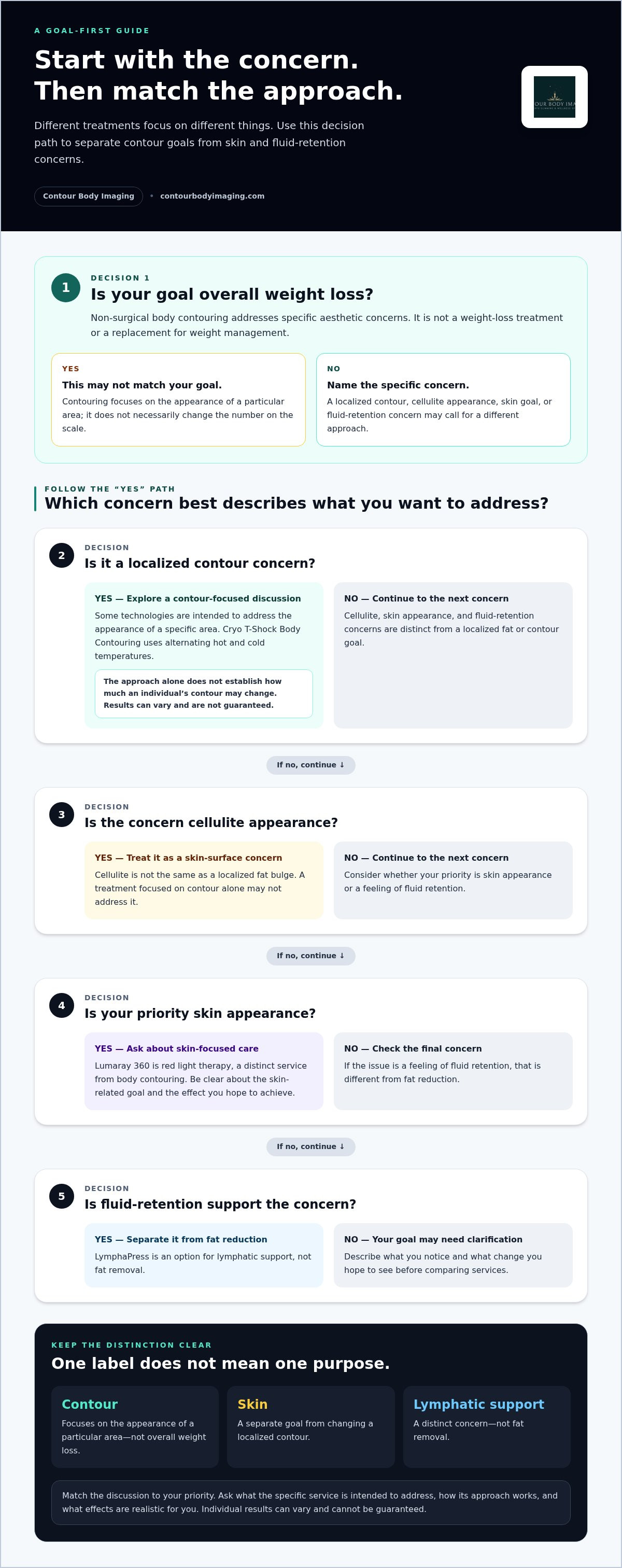
Start with the concern you want to address, not a device name. A visible bulge, dimpled skin, reduced firmness, and a feeling of fluid retention are different goals. This comparison can help you identify the type of care to discuss and what a treatment may realistically be intended to do.
Non-surgical treatments aren’t equivalent to liposuction or surgical skin removal. They don’t excise excess skin or remove tissue through surgery, so they may not address concerns that require a more substantial physical change. Keeping this distinction in mind helps set expectations and focus on the outcome you actually want.
Localized contour concerns versus cellulite appearance
A localized bulge and cellulite may appear in the same area, but they describe different features. Cryo T-Shock Body Contouring is Contour Body Imaging’s body-contouring service and uses alternating hot and cold temperatures. That describes the service’s approach, not a guaranteed reduction in a particular area. If cellulite is your concern, focus the conversation on its appearance rather than assuming a contour-focused service removes fat or ensures smoother skin.
Skin, circulation, and fluid-retention goals
Skin-focused care, circulation-related wellness, lymphatic support, and localized contouring have distinct aims. Lumaray 360 is red light therapy associated with cellular repair and skin health, but it shouldn’t be presented as a promise of contour change. Endosphere is a separate therapy in the clinic’s circulation-focused offerings, while LymphaPress supports lymphatic drainage. Neither should be described as a fat-removal treatment.
The goal should guide the treatment discussion. If you’re exploring non surgical body contouring, be specific about what you want to change and what you’d consider a meaningful outcome. That gives a personalized discussion a clear starting point, whether your priority is contour, skin appearance, or a separate wellness concern.
Results, Safety, and Preparation: What to Consider Before Treatment
A thoughtful plan starts with clear expectations and enough information to make a comfortable choice. Non surgical body contouring results can differ by person, technology, treated area, and the goal being addressed. A change in appearance isn’t the same as weight loss, improved health, or the reshaping possible through surgery. Treatment plans and follow-up vary, so don’t assume a particular timeline or number of sessions applies to everyone.
Setting realistic expectations for non-surgical results
Consider what outcome would feel worthwhile to you, and keep the goal specific. Changes may be subtle or limited, depending on the treatment and individual factors. Lifestyle habits may also affect how appearance changes are maintained. Discuss likely effects and limitations so you can decide whether the approach fits your priorities without relying on dramatic before-and-after claims.
Questions to discuss before a session
Use this sequence to prepare for a treatment conversation and understand the plan before moving forward:
Clarify your goal. Describe the area and the change you hope to see. Separate contour concerns from goals related to skin appearance or lymphatic support.
Review health considerations. Share relevant health conditions, medications, and past treatment experiences. Discuss these with an appropriate healthcare professional, particularly if you’re unsure how they may affect treatment suitability.
Discuss the device and intended area. Ask how the specific technology is used, what outcome it is intended to address, and what possible effects or risks apply to that device and treatment area.
Understand follow-up. Discuss what happens after the session, how progress will be reviewed, and what to do if you have concerns. Don’t assume every treatment has the same aftercare or follow-up plan.
Safety information should be specific, not generalized from one technology to another. The U.S. Food and Drug Administration’s overview of non-invasive body contouring technologies explains that potential effects and risks depend on the procedure and device. The broad label “body contouring” isn’t enough to tell you what a particular treatment involves. Discuss the specific device, intended use, and relevant safety information rather than assuming all options carry identical risks.
If you experience concerning symptoms after a treatment, seek prompt medical advice from an appropriate healthcare professional. Don’t rely on general information to assess a symptom or delay getting care.
Explore Non-Surgical Body Contouring at Contour Body Imaging
A useful starting point is the concern you want to focus on. Contour Body Imaging offers body contouring, skin-focused care, and lymphatic support in The Woodlands and Dallas, Texas. A goal-first discussion can help distinguish these aims and account for your preferences and relevant health considerations, without assuming one service fits every concern.
Match the conversation to the concern you want to address
Think about whether your priority is a localized contour, the appearance of cellulite, skin health, or fluid retention. These goals can call for different types of care. Cryo T-Shock Body Contouring is the clinic’s body-contouring service and uses alternating hot and cold temperatures. For a broader overview of non-surgical approaches, the non-invasive body sculpting guide can help you understand how treatment categories differ.
If cellulite appearance is your focus, Endosphere is a separate therapy to discuss in relation to that concern. A guide to Endosphere therapy and cellulite expectations offers more context. Keep expectations grounded: no service should be assumed to guarantee smoother-looking skin or address every cause of dimpling.
For skin-focused goals, Lumaray 360 is red light therapy. For lymphatic support, LymphaPress is a distinct option. Endosphere is also a separate therapy, so keep the discussion centered on your stated aim rather than treating these services as fat-removal methods or interchangeable choices.
Explore local options and take a comfortable next step
If you’re curious about Cryo T-Shock, read the Cryo T-Shock body contouring guide to learn more about the service. Then consider what you’d like to understand in a personalized discussion: the intended area, your goal, and any health considerations that may be relevant to treatment planning.
There’s no need to choose based on a technology label alone. Describing your concern clearly can keep the conversation practical, whether you’re exploring contouring, cellulite appearance, skin-focused care, or lymphatic support. Contour Body Imaging serves clients in The Woodlands and Dallas, Texas, with services for these distinct aesthetic and wellness goals.
Explore Contour Body Imaging’s services and arrange a visit to discuss which option aligns with your goals and expectations.
Take Your Next Step with a Goal in Mind
Before exploring a service, consider what specific change would make the conversation worthwhile for you. Defining it in your own words can keep decisions centered on your priorities rather than unfamiliar device names or someone else’s idea of an ideal result. Non surgical body contouring is a personal aesthetic choice, not a test of discipline or a shortcut to changing your whole body.
Your next step can be an opportunity to describe the concern you’d like to address, share relevant health considerations, and learn how an option may align with your goal. Give yourself room to ask questions, weigh the information, and decide at a pace that feels comfortable. A thoughtful choice starts with what matters to you.
Stay curious, trust your priorities, and move forward when the choice feels right for you.
Frequently Asked Questions
Is non-surgical body contouring the same as weight loss?
No. Non surgical body contouring focuses on the appearance of a particular area, while weight loss refers to a change in overall body weight. For example, a person might notice a difference in how clothing fits without seeing a major change on the scale, but individual results vary. Cosmetic treatments aren’t obesity care or a substitute for weight management. Discuss weight-related or health concerns with an appropriate healthcare professional.
Can non-surgical body contouring remove loose skin?
No. These treatments don’t surgically remove skin. Some technologies are intended to affect skin firmness or appearance, but possible effects depend on the approach and the individual. Mild looseness and significant excess skin are different concerns, so describe what you’re noticing rather than relying on a general label like “body sculpting.” A qualified professional can help you understand whether your goal is realistic for a non-surgical approach.
How many sessions of non-surgical body contouring are needed?
There isn’t one session count that fits every treatment or person. The service, area, and goal all influence the plan, and a particular number of visits can’t guarantee a specific result. Before beginning, ask how progress will be assessed and what factors might lead to changes in the plan. This helps you decide whether the proposed commitment fits your schedule and expectations.
Is non-surgical body contouring FDA-approved?
There isn’t a single FDA approval that applies to every body-contouring treatment. Regulatory status and authorized uses relate to the specific device and indication, and some devices may be cleared rather than approved. Look up the exact technology and intended use in FDA information instead of applying one device’s status to another. FDA status also doesn’t promise a particular cosmetic outcome, so consider the treatment’s stated purpose separately.
Is non-surgical body contouring safe for everyone?
No. Whether a treatment is appropriate depends on the technology, treatment area, and your health history. Before proceeding, share relevant conditions, medications, prior procedures, and concerns with an appropriate healthcare professional. A medication or health issue you consider routine may still matter to an individualized safety discussion. Use device-specific information to understand possible risks rather than assuming a general description applies to every treatment.
Does non-surgical body contouring hurt?
Not everyone experiences a treatment the same way, and sensations can differ between technologies and treatment areas. Ask what the specific session may feel like, whether sensations can change during treatment, and how to communicate discomfort. Don’t assume a procedure will be pain-free based on a general description or someone else’s experience. If you notice unusual or concerning symptoms during or after treatment, seek advice from an appropriate healthcare professional.
Can non-surgical body contouring treat cellulite?
Some services are intended to address the appearance of cellulite, but that goal differs from targeting a localized bulge, and results aren’t guaranteed. If cellulite is your concern, focus the conversation on the skin’s appearance and the service’s intended purpose. Endosphere is a distinct therapy at Contour Body Imaging, serving clients in The Woodlands and Plano, Texas. Don’t assume it removes fat or ensures smoother skin.

Comments